
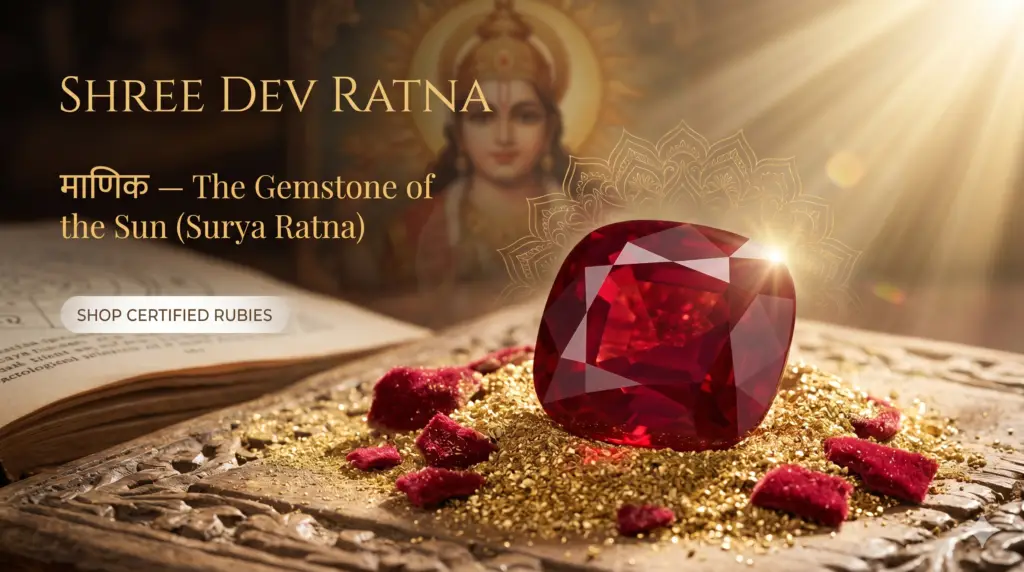
Ruby (Manik Stone)

माणिक — The Gemstone of the Sun | Surya Ratna

Full Product Description

What is a Ruby (Manik)?

Ruby, known as Manik or Manikya in Sanskrit, is one of the four precious gemstones of the world alongside Emerald, Sapphire, and Diamond. A variety of the mineral corundum (aluminium oxide), Ruby gets its signature vivid red color from the presence of chromium. The deeper and more saturated the red, the more valuable the stone.

In Vedic Jyotish (astrology), Ruby is the Navratna gemstone of the Sun (Surya) the king of all planets. The Sun governs the soul (Atma), authority, leadership, confidence, and the relationship with one’s father. Wearing a natural, unheated Ruby channels the Sun’s powerful energies directly to the wearer.

The Legend & History of Ruby

Ruby has been treasured for over 2,500 years across Indian, Burmese, Greek, and Roman civilizations. Ancient Indian texts including the Ratna Pariksha refer to Ruby as ‘Ratnaraj’ the King of Gemstones. Burmese warriors embedded rubies in their skin before battle, believing the stone made them invincible. European royalty coveted rubies as symbols of power and eternal youth.

In Hindu tradition, the Ruby is called ‘Surya Mani’ jewel of the Sun. Mughal emperors adorned their crowns with rubies; the famous Timur Ruby (actually a spinel) once mistaken for a ruby graced the British Crown Jewels.

Types of Ruby by Origin

  • : The most prized ruby in the world. Mined in Mogok, Myanmar known for its vivid red with a hint of blue fluorescence under UV light. The term ‘Pigeon Blood’ describes the ideal rich, pure red.
  • : High iron content produces vivid, bright red stones often with good transparency. Mozambique has become the leading source since 2009, offering excellent value.
  • : Lighter pinkish-red to medium red, high clarity, excellent brilliance. Ideal for those who prefer a brighter, less intense red.
  • : Dark, brownish-red tones. Widely heat-treated. Affordable but lower in astrological potency.
  • : Rare, lighter red to pinkish; similar geology to Kashmir. Limited commercial availability.

Technical Specifications

Gemstone Name

Ruby (Manik / Manikya)

Mineral Species

Corundum (Al₂O₃)

Chemical Formula

Aluminium Oxide with Chromium (Cr³⁺)

Crystal System

Trigonal (Hexagonal)

Hardness (Mohs)

9.0 Second hardest natural mineral

Refractive Index

1.762 – 1.778 (birefringence: 0.008–0.010)

Specific Gravity

3.97 – 4.05

Luster

Vitreous to sub-adamantine

Transparency

Transparent to opaque

Color Range

Pinkish-red, medium red, deep red, Pigeon Blood red

Cleavage

None excellent toughness

Fluorescence

Strong red under UV (especially Burmese)

Common Treatments

Heat treatment, beryllium diffusion, fracture filling

Best Origins

Myanmar (Burma), Mozambique, Sri Lanka

Ruling Planet

Sun (Surya)

Chakra

Manipura (Solar Plexus) / Anahata (Heart)

Zodiac (Rashi)

Leo (Simha) primary; also Aries, Scorpio

Recommended Weight

Minimum 3 Ratti (2.7 ct) for astrological use

Setting Metal

Gold (22K, 18K) or Panchdhatu

Wearing Finger

Ring finger, right hand

Auspicious Day

Sunday, during Shukla Paksha (waxing moon)

Mantra

Om Hraam Hreem Hraum Sah Suryaya Namah (108 times)

Astrological & Health Benefits

👑 Authority & Leadership

Strengthens commanding presence

💪 Vitality & Health

Boosts energy and immunity

☀️  Sun’s Blessings

Activates solar energy in the body

💼 Career Growth

Accelerates professional advancement

🧠 Confidence

Removes self-doubt and fear

❤️  Heart Health

Supports cardiovascular wellness

👁️  Eye & Bone Health

Traditionally aids vision & spine

🏆 Fame & Recognition

Attracts public honor & respect

👨 Father Relationship

Improves ties with father/authority figures

💡 Clarity of Mind

Dispels confusion, sharpens focus

🔥 Willpower

Strengthens resolve & determination

🌟 Spiritual Protection

Shields from negative energies

How to Choose the Best Ruby Quality Guide

The 4Cs of Ruby Quality

Color The Most Important Factor

Color accounts for approximately 50–60% of a ruby’s value. The ideal color is ‘Pigeon Blood Red’ a vivid, pure red with a slight blue undertone, neither too dark nor too light. The stone should retain its color under all lighting conditions, including incandescent and fluorescent light.

  • Preferred hue: Pure red (70–80% saturation)
  • Preferred tone: Medium to medium-dark (not inky or pale)
  • Avoid: Brownish, orangey, or purplish-red tones for astrological use

Clarity

Ruby belongs to Type II gemstones meaning natural inclusions (called ‘silk’) are expected and accepted. A completely inclusion-free ruby is exceptionally rare and commands astronomical prices.

  • Eye-clean rubies with fine silk: Excellent for both beauty and astrology
  • Slight inclusions visible under 10x magnification: Acceptable
  • Heavy inclusions affecting transparency: Avoid for astrological use

Cut

Ruby is most commonly cut in oval, cushion, or round shapes to maximize color retention and brilliance. Cabochon-cut rubies (smooth, dome-shaped) are preferred when the stone shows asterism (Star Ruby) and are also used in astrological settings.

Carat Weight (Ratti)

For astrological purposes, weight is measured in Ratti (1 Ratti = 0.9 carats). The minimum recommended weight for visible astrological effect is 3 Ratti (approximately 2.7 carats), ideally worn in gold.

How to Wear Ruby Complete Ritual Guide

Step-by-Step Wearing Ritual

  • Day & Time: Sunday morning, 1–2 hours after sunrise, during Shukla Paksha (waxing moon fortnight).
  • Purification: Immerse the ring in raw cow’s milk, honey, and Ganga jal (holy water) for 10 minutes. Pat dry with a clean cloth.
  • Energization: Place the ring on a clean red cloth. Light a ghee lamp and incense. Chant the Surya mantra 108 times.
  • Mantra: ‘Om Hraam Hreem Hraum Sah Suryaya Namah’ chant 108 times facing the East (direction of the rising Sun).
  • Wearing: Wear on the ring finger of the right hand. Offer a prayer to the Sun before sliding the ring on.
  • Maintenance: Clean monthly with mild soap and water. Re-energize every 6 months with the same ritual. Replace if the stone cracks or loses luster.

Metal, Finger & Setting

Preferred Metal

22K or 18K Yellow Gold

Alternative Metal

Panchdhatu (Five-metal alloy)

Finger

Ring finger (Anamika), right hand

Setting Style

Open back / Prong set allows stone to touch skin

Minimum Carat

3 Ratti (2.7 ct) for astrological results

Ideal Weight

5–7 Ratti (4.5–6.3 ct) for full effect

Certifications & Authenticity

All Shree Dev Ratna rubies are certified by internationally recognized gemological laboratories. Certification guarantees natural origin, treatment disclosure, and accurate weight/quality grading.

GRS (Gem Research Swiss)

Swiss lab the global gold standard for ruby origin & pigeon blood certification

GIA (Gemological Inst.)

Most recognized worldwide; provides origin reports for fine rubies

Gubelin Gem Lab

Swiss prestige lab preferred by auction houses for Burmese rubies

IGI (Int’l Gem Institute)

Widely accepted in India; provides origin and treatment reports

GTL Jaipur

GJEPC-affiliated; trusted for domestic Indian market

Shree Dev Ratna Promise: Every ruby listed on our platform is natural, ethically sourced, and accompanied by a lab certificate. We provide complete treatment disclosure. No synthetics, no simulants, ever.

Frequently Asked Questions

Ruby is a precious corundum gemstone known as Manik (माणिक) or Manikya in Hindi and Sanskrit. It is the birthstone for July and the Navratna stone representing the Sun (Surya) in Vedic astrology. It belongs to the same mineral family as Blue Sapphire and Yellow Sapphire all three are varieties of corundum, with Ruby being the red variety.

Ruby is most beneficial for individuals with Leo (Simha) ascendant and for those whose Sun is placed in a strong, favorable position in their horoscope. It is also recommended during the Sun Mahadasha or Antardasha period. Professionals in leadership, medicine, law, and government service typically benefit the most. Always consult a qualified Vedic astrologer before wearing.

Ruby should be worn on the ring finger (Anamika) of the right hand, set in 22K or 18K yellow gold. The setting should be open-backed so the stone directly touches the skin, allowing its energies to be absorbed. Wearing in silver or white gold is not recommended for maximum astrological benefit.

The minimum recommended weight is 3 Ratti (approximately 2.7 carats). For stronger results, a stone of 5 to 7 Ratti (4.5 to 6.3 carats) is ideal. The stone should be natural, untreated or heat-treated (not beryllium-diffused or glass-filled), and certified by a recognized gemological laboratory.

Burmese (Myanmar) rubies especially the Pigeon Blood grade from Mogok are the most prestigious and expensive in the world due to their fluorescent red glow and exceptional color saturation. Mozambique rubies offer a vivid, bright red at a more accessible price point and have excellent transparency. Both are equally effective astrologically; the difference is primarily in rarity, origin prestige, and price.

Pigeon Blood is the most coveted color grade for ruby a vivid, saturated red with a slight bluish overtone, resembling the color of the first two drops of blood from a freshly killed pigeon (a traditional Burmese comparison). This grade is certified by top laboratories like GRS and commands the highest prices in the gemstone world. True Pigeon Blood rubies almost exclusively originate from the Mogok Valley, Myanmar.

Heat-treated rubies retain their astrological properties and are widely used in Vedic astrology. However, unheated, untreated rubies (certified as ‘no heat’ by GRS or GIA) are considered more potent and are preferred for serious astrological purposes. Rubies with beryllium diffusion, glass filling, or fracture filling are NOT recommended for astrological use, as the treatment significantly compromises the stone’s natural integrity

The most reliable way is to purchase a ruby with a certificate from a reputed lab (GRS, GIA, IGI, or Gubelin). At home, genuine rubies show strong red fluorescence under a UV flashlight, have no bubbles inside (which indicate glass simulants), and feel cold to the touch unlike glass. For a definitive test, take it to a certified gemologist with professional equipment.

Ruby pairs well with Yellow Sapphire (Pukhraj) and Pearl all three represent friendly planets (Sun, Jupiter, Moon). Ruby should NOT be combined with Blue Sapphire (Saturn is enemy of Sun), Hessonite/Gomed (Rahu), Cat’s Eye (Ketu), or Diamond (Venus) without careful astrological consultation, as these represent planets hostile to the Sun.

Scroll to Top